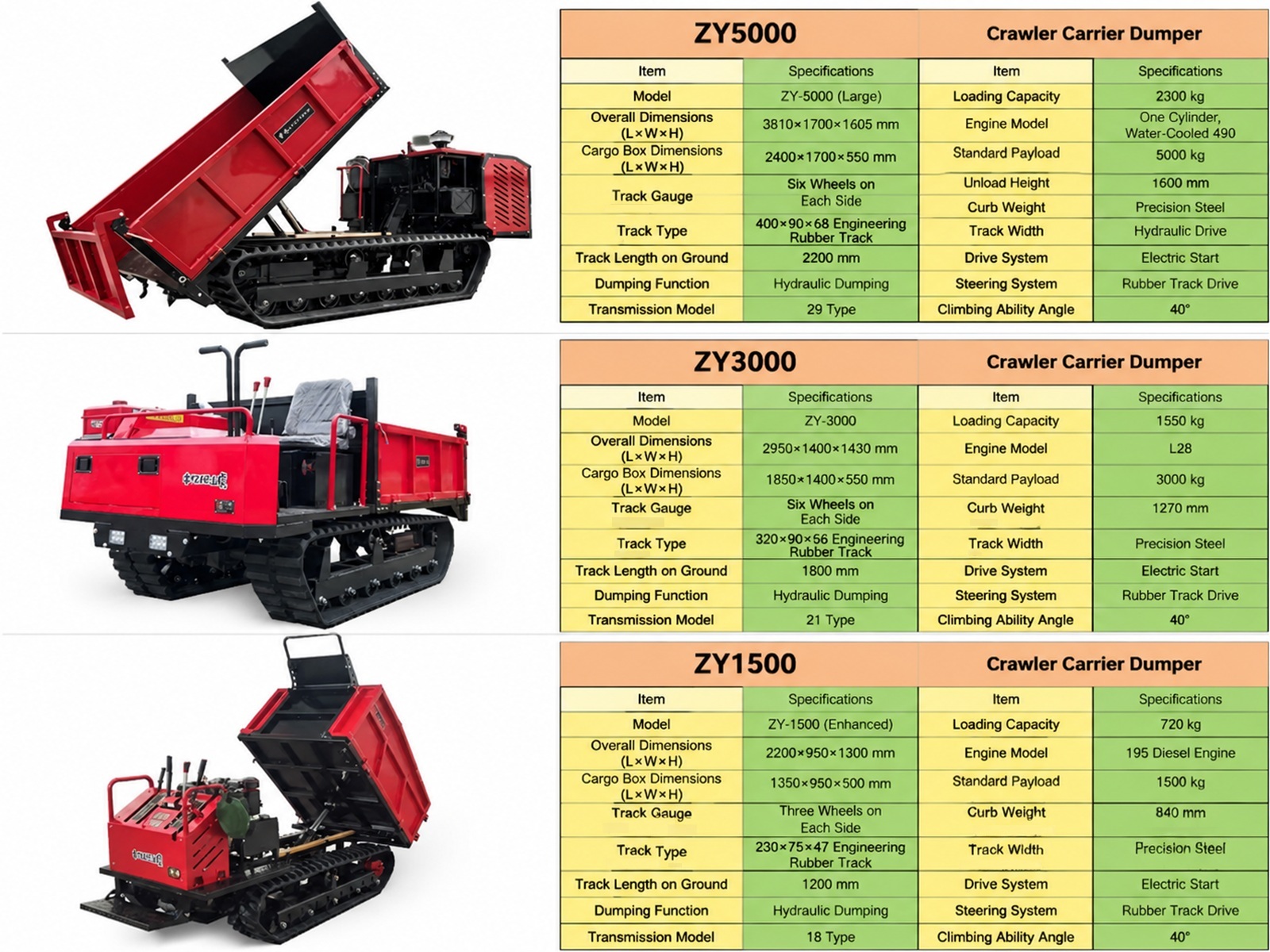
Transporters are essential for moving materials on construction sites, farms, and forestry operations. The choice between tracked and wheeled transporters depends on your terrain, load capacity needs, and working conditions.
1. Tracked Transporter Overview
Advantages
- Superior traction: Excellent on mud, snow, sand, and uneven terrain
- Low ground pressure: Minimal soil compaction — ideal for soft ground and agricultural applications
- Stability: More stable on slopes and uneven ground
- Climbing ability: GTFI tracked transporters climb up to 40°
Disadvantages
- Slower speed: Typically 5-15 km/h
- Higher maintenance: Tracks and undercarriage require more maintenance
- Higher cost: More expensive than wheeled equivalents
- Not suitable for paved roads: Can damage pavement
2. Wheeled Transporter Overview
Advantages
- Faster speed: Up to 30-40 km/h
- Lower cost: Less expensive to purchase and maintain
- Better on paved roads: Suitable for road travel
- Lower fuel consumption: More efficient on hard surfaces
Disadvantages
- Poor traction: Can get stuck in mud or soft ground
- Higher ground pressure: More likely to cause soil compaction
- Less stable: More likely to tip on slopes
- Limited climbing: Lower climbing angle (typically 20-25°)
3. Comparison Table
| Feature | Tracked Transporter | Wheeled Transporter |
|---|---|---|
| Terrain Suitability | Mud, snow, soft ground | Hard surfaces, paved roads |
| Climbing Angle | 40° | 20-25° |
| Top Speed | 5-15 km/h | 30-40 km/h |
| Ground Pressure | Low | High |
| Maintenance | Higher | Lower |
| Cost | Higher | Lower |
| Load Capacity | 1.5-5 tons (GTFI) | Varies |
4. How to Choose
- Choose Tracked if: You work on soft ground, mud, slopes, or snow. Ideal for construction sites, orchards, forestry, and off-road applications.
- Choose Wheeled if: You work on paved roads, hard surfaces, or need to travel long distances. Ideal for warehouses, factories, and urban construction.
Mobility Decision
Tracked transporters usually prioritize traction and low ground pressure, while wheeled machines can favor faster travel on suitable surfaces. Match the undercarriage to terrain, slope, payload, and transport route.
What to Confirm Before Ordering
- Define the material, digging or carrying task, working depth, reach, and expected daily workload.
- Check operating weight, machine width, height, ground clearance, turning space, and transport dimensions against the job site.
- Match engine power, hydraulic flow, attachment compatibility, and control system to the intended attachment and duty cycle.
- For tracked machines, consider slope, ground pressure, traction, mud, and the balance between mobility and payload.
- Confirm service access, wear parts, attachment availability, transport arrangements, and operator requirements before ordering.
For a quotation request: For quotation requests, provide the site conditions, required attachment, material, working depth or payload, access limits, destination country, and expected quantity. This produces a much more useful equipment recommendation.
Need help matching equipment to a specific application? Provide the operating conditions, required quantity, destination, and key technical requirements when requesting a quotation.
❓ Frequently Asked Questions
A: Yes, but it may damage the road surface. Rubber tracks cause less damage than steel tracks.
A: Tracked transporters are better for orchards due to low ground pressure and ability to work on soft soil.
A: GTFI ZY Series tracked transporters offer 1.5-5 tons load capacity.
💬 Not sure which transporter is right for you?
Talk to Our Experts →