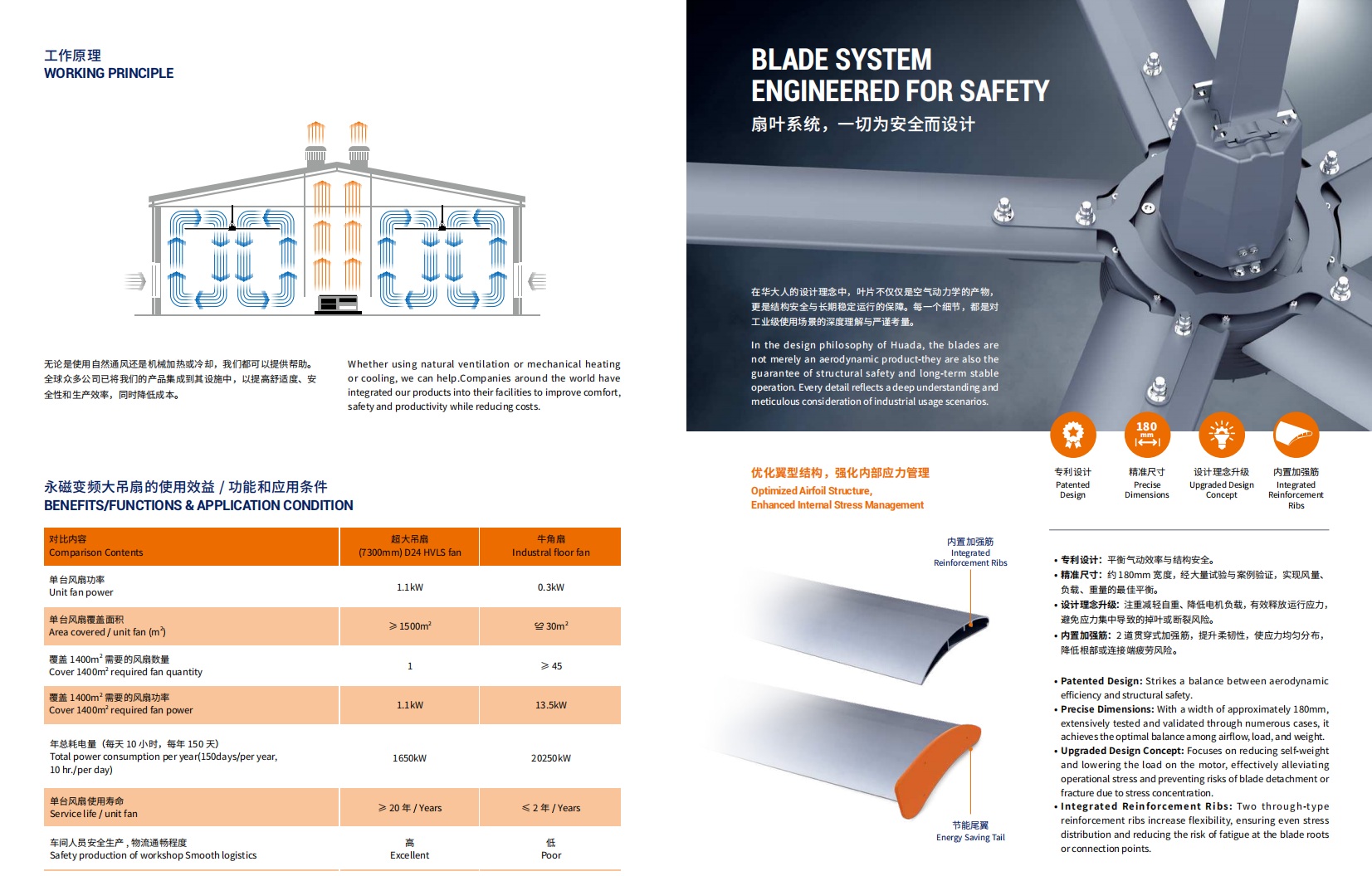
Industrial HVLS fans are engineered air movement systems that can dramatically improve comfort, reduce energy costs, and enhance productivity in large spaces. Unlike traditional high-speed fans that create localized breeze, HVLS fans move air throughout the entire space with gentle, consistent airflow.
GTFI's HVLS fans feature PMSM direct-drive motors achieving up to 50% energy savings compared to traditional AC motor fans, with ultra-quiet operation as low as 38dB.
1. What Is an HVLS Fan?
HVLS stands for High Volume, Low Speed. These fans are characterized by:
- Large diameter: 3.0m to 7.3m
- Low rotational speed: 55-120 rpm
- High airflow: Moving 4,000 to 13,000 m³/min
- Energy efficiency: Moving large air volumes with minimal power
2. Diameter Selection – Which Size Do You Need?
| Diameter | Model | Power | Airflow | Coverage | Best For |
|---|---|---|---|---|---|
| 3.0m | HDS-3.0 | 0.37kW | 4,000 m³/min | ≤380㎡ | Small workshops, offices |
| 3.7m | HDS-3.7 | 0.75kW | 5,000 m³/min | ≤450㎡ | Medium factories, gyms |
| 5.0m | HDS-5.0 | 1.5kW | 10,000 m³/min | ≤1,300㎡ | Warehouses, logistics centers |
| 7.3m | HDS-7.3 | 1.1kW | 13,000 m³/min | ≤1,700㎡ | Very large venues, aircraft hangars |
How to Choose Diameter by Space
- Ceiling height 4-6m: 3.0-3.7m diameter recommended
- Ceiling height 6-10m: 3.7-5.0m diameter optimal
- Ceiling height 10-15m: 5.0-7.3m diameter delivers best results
3. Motor Technology – PMSM vs AC
| Feature | PMSM Direct-Drive | AC Motor + VFD |
|---|---|---|
| Efficiency | Grade 1 (92%) | Grade 3 (78-82%) |
| Energy Saving | Up to 50% | Baseline |
| Noise Level | ≤38dB | 50-65dB |
| Maintenance | Low (direct-drive) | Higher (belt/gearbox) |
| Motor Warranty | 3 years | 1-2 years |
4. GTFI HVLS Fan Series Overview
- HDS Series: 3.0-7.3m, industrial ceiling fans for factories and warehouses
- HDS-D Series: 2.4-3.7m, commercial ceiling fans for gyms and retail
- HDY Series: 1.2-2.0m, portable fans for outdoor and temporary use
- HDB Series: 1.2-2.0m, wall-mounted fans for space-saving installation
- HDS-L Series: 3.0-7.3m, floor-standing fans for flexible placement
- AFS Series: 2.4-3.7m, garden and outdoor fans for courtyards
5. Energy Savings Calculation
A 5.0m GTFI HVLS fan with PMSM motor uses 1.5kW vs a traditional AC fan using 3.0kW. Operating 10 hours/day, 300 days/year:
- AC fan: 3.0kW × 10h × 300 = 9,000 kWh/year
- GTFI PMSM fan: 1.5kW × 10h × 300 = 4,500 kWh/year
- Annual savings: 4,500 kWh × $0.12 = $540 per fan per year
Coverage Planning
For large spaces, fan diameter, mounting height, airflow pattern, obstacles, heat sources, and multiple-fan layout should be evaluated together. A coverage plan is more useful than selecting a fan only from floor area.
What to Confirm Before Ordering
- Record floor area, ceiling height, heat sources, occupancy, doors, and natural ventilation before comparing models.
- For fans, compare airflow, air velocity, coverage, speed control, mounting height, and noise rather than diameter alone.
- For cooling equipment, define target temperature, heat load, humidity, refrigerant/cooling method, and available electrical supply.
- Check dust, moisture, corrosive gases, outdoor exposure, and cleaning requirements when selecting protection and construction materials.
- Confirm installation clearances, controls, maintenance access, and whether several smaller units would distribute air more effectively than one large unit.
For a quotation request: For quotation requests, provide room dimensions, application, climate, electrical supply, preferred mounting method, and target operating conditions. This allows suppliers to recommend a suitable configuration rather than simply quoting the largest available model.
Need help matching equipment to a specific application? Provide the operating conditions, required quantity, destination, and key technical requirements when requesting a quotation.
❓ Frequently Asked Questions
A: Yes! Run HVLS fans in reverse to push warm air trapped at the ceiling back down to floor level, reducing heating costs.
A: Divide your total floor area by the coverage area of one fan. For a 1,000㎡ warehouse with 5.0m fans (1,300㎡ coverage), one fan is sufficient.
A: All GTFI HVLS fans operate at ≤38dB — quieter than a library.
💬 Need help selecting the right HVLS fan?
Talk to Our Experts →