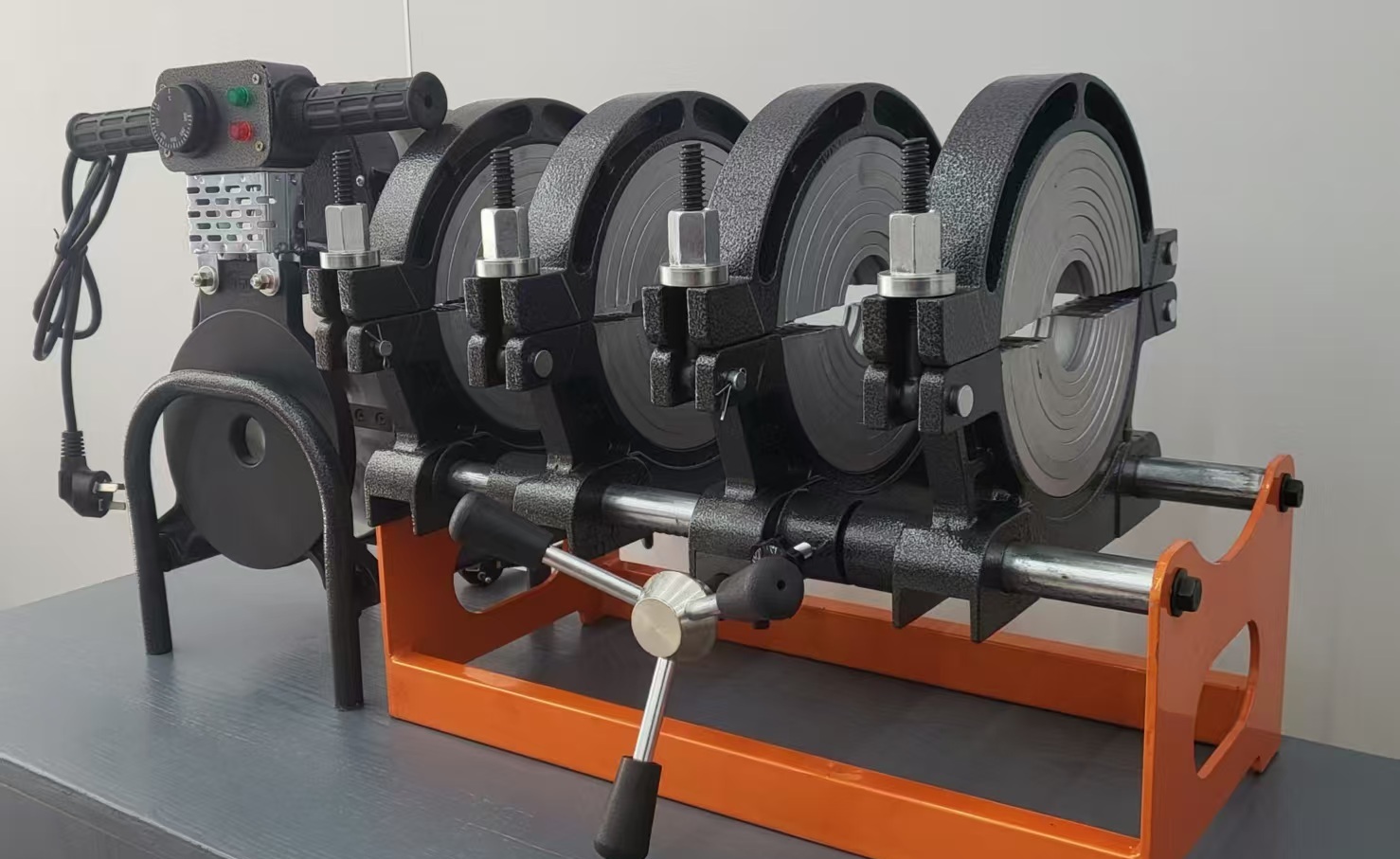
When working with PE (polyethylene) and PP (polypropylene) pipes, two primary welding methods are used: butt fusion and electrofusion. Both produce strong, leak-free joints, but they are suited for different applications and project conditions.
1. What Is Butt Fusion Welding?
Butt fusion welding involves heating the ends of two pipe sections using a heated plate, then pressing them together under controlled pressure to form a uniform joint. The process includes:
- Facing: Milling the pipe ends to ensure flat, parallel surfaces
- Heating: Applying heat via a PTFE-coated heating plate (typically 210–270°C)
- Joining: Removing the plate and pressing the heated ends together
- Cooling: Allowing the joint to cool under pressure
GTFI Butt Fusion Equipment:
- SHBD Series: 63–1600mm manual and hydraulic butt fusion machines
- ABBD Series: 90–630mm automatic butt fusion with data logging (500+ records)
- SHBDSY Series: Manual hydraulic for smaller diameters (63–200mm)
All GTFI butt fusion machines feature ZL104 aluminum alloy frames, PTFE-coated heating plates, and high-precision pressure control for consistent weld quality.
2. What Is Electrofusion Welding?
Electrofusion welding uses specially manufactured fittings with built-in heating coils. The pipe is inserted into the fitting, and an electric current is passed through the coil, melting the interface and creating a joint. The process is controlled by an electrofusion controller that monitors voltage, current, and time.
GTFI Electrofusion Equipment:
- BDDR-315A: Standard automatic electrofusion, 315A output
- BDDR-315W: Barcode scanning, auto-test, soft-start, data logging
- BDDR-400V: Heavy-duty, moisture/shock-proof, for outdoor use
- BDDR-5000V: Large-diameter capability, multi-parameter control
3. Direct Comparison Table
| Feature | Butt Fusion | Electrofusion |
|---|---|---|
| Pipe Diameter Range | 20–1600mm | 20–630mm (fittings dependent) |
| Weld Strength | Uniform, high strength | Good, but joint is within fitting |
| Weld Time | 10–60 minutes (includes cooling) | 2–10 minutes (faster) |
| Space Requirement | Significant – machine length | Minimal – only fitting + controller |
| Equipment Cost | Higher (machine + clamps + heater) | Lower (controller + fittings) |
| Operator Skill | Higher skill required | Lower – automated process |
| Data Recording | Manual or automatic (ABBD series) | Automatic (all BDDR models) |
| Best For | Main pipelines, large diameters | Repairs, branches, confined spaces |
4. Detailed Comparison by Application
Butt Fusion – Best For:
- Long pipeline installations: Water supply, gas distribution, industrial piping
- Large diameters: 160–1600mm pipes
- New construction projects: Where access is not restricted
- Applications requiring high weld strength: Pressure pipes, buried pipelines
- Cost-sensitive projects: No fittings required – just the pipe itself
Electrofusion – Best For:
- Repair and maintenance: Replacing damaged sections without moving long pipe lengths
- Branch connections: Tees and branches from main pipelines
- Confined spaces: Manholes, trenches, where butt fusion machines cannot fit
- Small diameters: 20–110mm pipes
- Quick repairs: Fast weld time (2–10 minutes)
- Projects needing data traceability: All BDDR controllers log weld data automatically
5. GTFI Product Recommendations
| Application | Recommended Equipment |
|---|---|
| Small pipelines (20–160mm) | SHBDSY series (manual) or SHBD160 (hydraulic) |
| Medium pipelines (160–315mm) | SHBD315, ABBD315 (automatic with data logging) |
| Large pipelines (400–630mm) | SHBD630, ABBD630 (automatic) |
| Very large pipelines (800–1600mm) | SHBD800, SHBD1000, SHBD1200, SHBD1600 |
| Field repairs & branches | BDDR-315W (barcode, auto-test) or BDDR-400V (outdoor) |
| Fittings welding (elbows, tees) | SHBG315–1600 series (fittings welders) |
Practical Selection Checklist
Pipe joining equipment should be selected from pipe material, diameter range, wall thickness, joining standard, site conditions, and required production rate. The joining method affects equipment size, consumables, preparation, operator training, and inspection.
What to Confirm Before Ordering
- Identify pipe material, outside diameter range, wall thickness, and the joining standard used on the project.
- Choose the process according to material compatibility, joint requirements, field conditions, and required production speed.
- Check heating or welding temperature/control range, clamping capacity, hydraulic or electrical requirements, and alignment accuracy.
- Consider portability, site power, weather protection, transport cases, and the ability to work in confined or remote areas.
- Confirm replacement heaters, clamps, cutters, control components, calibration requirements, and after-sales support.
For a quotation request: For quotation requests, provide pipe material, diameter, wall thickness, joint type, project location, power supply, and expected production volume. Project standards or drawings are valuable when available.
Need help matching equipment to a specific application? Provide the operating conditions, required quantity, destination, and key technical requirements when requesting a quotation.
❓ Frequently Asked Questions
A: Butt fusion produces a joint that is as strong as the pipe itself. Electrofusion joints are also strong but depend on the quality of the fitting.
A: Yes, but fittings become expensive and difficult to handle. Butt fusion is more economical for diameters above 315mm.
A: Both butt fusion and electrofusion are primarily used for PE (HDPE) and PP pipes. GTFI equipment supports multiple materials including HDPE, PP, PVDF, and MPP.
💬 Need help choosing the right pipe welding method?
Talk to Our Engineers →