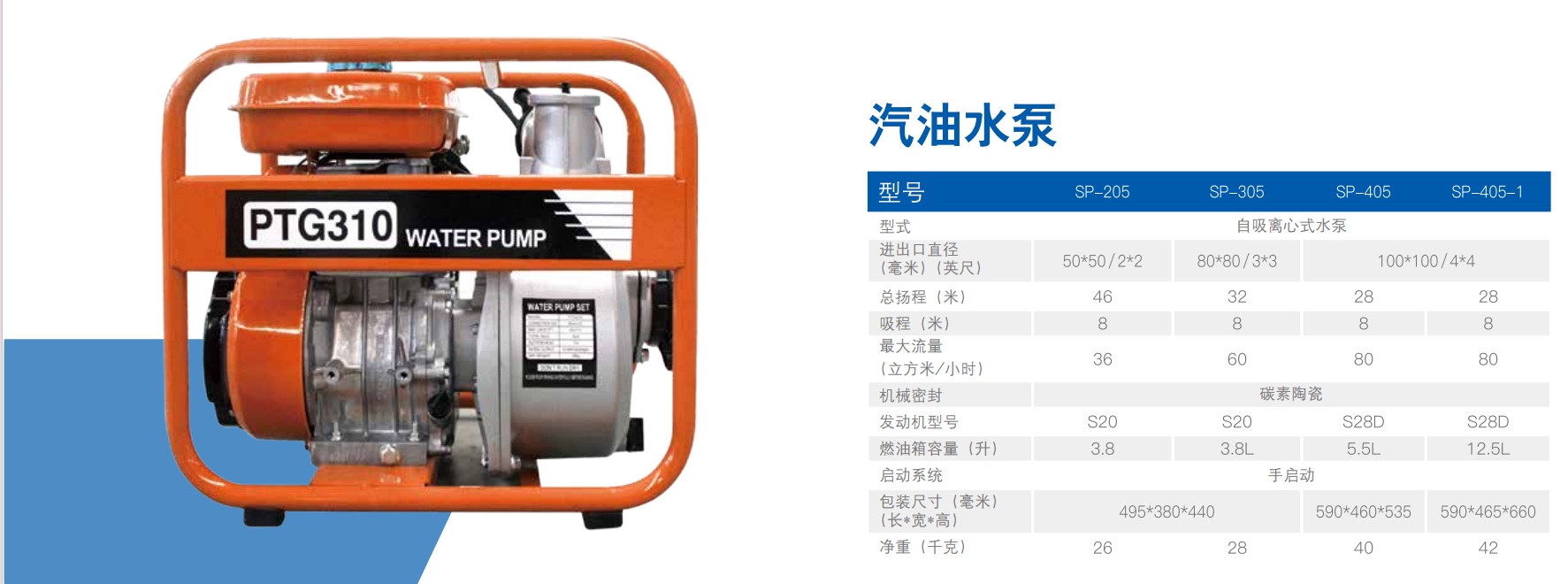
Water pumps are among the most commonly used equipment in industry and agriculture. However, many users are unaware that clean water pumps and sewage pumps have fundamental design differences. Choosing the wrong type not only leads to rapid pump failure but can also contaminate water sources or cause pipe blockages.
GTFI offers a complete range of clean water and sewage pumps, including gasoline and diesel-driven models, meeting needs from agricultural irrigation to municipal drainage.
1. Clean Water Pumps
How it works: Designed for conveying clean or lightly contaminated water (such as tap water, well water, rainwater). The impeller is optimized for flow rate and head efficiency.
- Water quality: Clean water, no solid particles or small particles (<5mm)
- Impeller type: Closed impeller, high efficiency, high flow rate
- Materials: Cast iron, stainless steel, aluminum (lightweight)
- Typical applications: Agricultural irrigation, domestic water supply, industrial circulating water
2. Sewage Pumps
How it works: Designed for conveying wastewater containing solid particles, fibers, or viscous substances. Features larger flow passages and cutting devices to prevent clogging.
- Water quality: Wastewater containing solid particles, fibers, sediment
- Impeller type: Open or semi-open impeller, strong solids handling
- Materials: Wear-resistant cast iron, stainless steel
- Typical applications: Municipal drainage, septic tanks, industrial wastewater
3. Detailed Comparison Table
| Feature | Clean Water Pump | Sewage Pump |
|---|---|---|
| Applicable Media | Clean, lightly contaminated water | Wastewater with solids |
| Solids Handling | <5mm | 20-50mm (model dependent) |
| Impeller Type | Closed impeller | Open / semi-open impeller |
| Efficiency | High (65-85%) | Moderate (50-70%) |
| Head | Higher (up to 80m+) | Moderate (typically ≤30m) |
| Abrasion Resistance | Moderate | High (wear-resistant materials) |
| Price | Lower | Higher |
4. How to Choose
Choose a clean water pump if:
- You are pumping clean water or clean water
- Solid particle content is low (<5mm)
- High head and efficiency are required
- Used for agricultural irrigation or domestic water supply
Choose a sewage pump if:
- You are pumping wastewater or sewage
- Water contains solid particles or fibers
- Large passage is needed to prevent clogging
- Used for municipal drainage, septic tanks, or construction site dewatering
Practical Selection Checklist
Pump and valve selection should start with the fluid and the required flow or pressure conditions. Materials, seals, temperature, solids content, corrosion, and operating cycle can be just as important as nominal size.
What to Confirm Before Ordering
- Define required flow rate, pressure or head, suction conditions, and the operating range rather than one single nominal point.
- Identify the fluid, temperature, viscosity, solids content, corrosiveness, and whether the service is clean, abrasive, or sanitary.
- For valves, specify the control or isolation duty, pressure class, connection standard, body material, seat/seal material, and actuation.
- Check motor power, efficiency, NPSH or suction conditions, installation orientation, and maintenance access for pumps.
- Confirm local pipe standards, replacement parts, seals, and compatibility with the existing system before purchase.
For a quotation request: For quotation requests, provide fluid type, flow, head/pressure, temperature, pipe size, material preference, connection standard, and quantity. A simple system diagram can remove significant ambiguity.
Need help matching equipment to a specific application? Provide the operating conditions, required quantity, destination, and key technical requirements when requesting a quotation.
❓ Frequently Asked Questions
A: No. Clean water pumps are not designed with large passages. Solid particles will clog the impeller, damage the pump, and may cause the motor to burn out.
A: Yes, but sewage pumps have lower efficiency than clean water pumps and consume more energy. Use only for temporary or emergency purposes.
A: Observe the maximum particle diameter in the water sample. If it's larger than 5mm, choose a sewage pump. If it's under 5mm and contains no fibers, a clean water pump may be suitable.
A: GTFI sewage pumps (STP series) can handle solid particles from 20-50mm depending on the model, covering most wastewater applications.
💬 Not sure which pump to choose?
Talk to Our Experts →