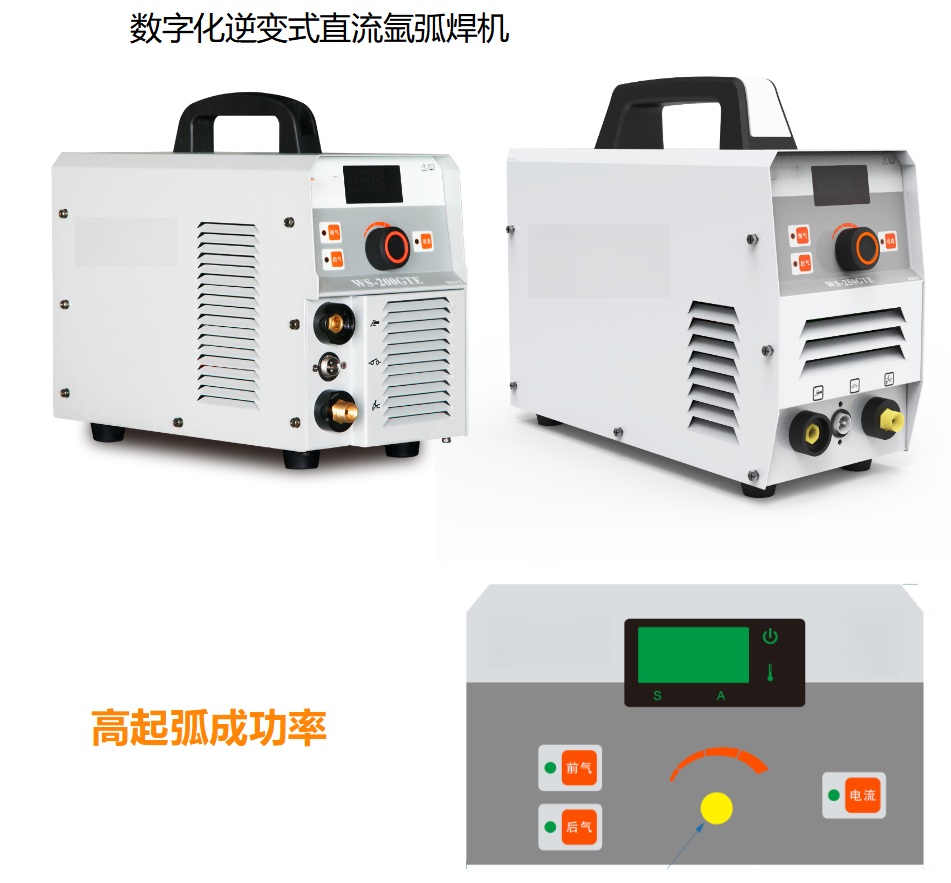
TIG (Tungsten Inert Gas) welding is one of the most precise welding processes, known for high-quality welds, no spatter, and suitability for thin materials and non-ferrous metals. It is widely used in aerospace, precision manufacturing, food equipment, and pipeline engineering.
GTFI offers a complete TIG welder product line, including WS series DC TIG and WSM series AC/DC pulsed TIG, with current ranges from 5-500A, meeting needs from precision electronics to heavy industrial applications.
1. TIG Welder Types
- DC TIG: Suitable for stainless steel, carbon steel, copper, titanium, and other metals. GTFI WS series offers 5-500A current range.
- AC/DC TIG: Suitable for aluminum, magnesium, and other non-ferrous metals. GTFI WSM series offers AC pulse function for effective oxide layer cleaning.
- Pulsed TIG: Controls heat input through pulsed current, reducing distortion, ideal for thin sheets. GTFI WSM series offers pulse frequencies up to 2000Hz.
2. Key Selection Parameters
| Parameter | Range | Description |
|---|---|---|
| Welding Current | 5-500A | 5-200A for thin sheets; 200-500A for thick materials |
| Input Voltage | 220V / 380V | 220V for ≤250A; 380V for ≥250A |
| Arc Starting | High-frequency / Lift | High-frequency is faster; lift-start is safer |
| Pulse Function | Yes / No | Suitable for thin sheets and gap-filling applications |
3. GTFI TIG Welder Recommendations
- WS-200GTE: 5-200A, 220V, high-frequency start — ideal for thin stainless steel welding
- WS-250GTE: 5-250A, 220V, high-frequency start — ideal for medium-thickness stainless steel
- WS-300GTS: 5-300A, 220/380V dual-voltage — versatile for multiple applications
- WSM-250GTE: 5-250A, 220V, pulse function — ideal for thin aluminum sheets
- WSM-400T: 5-400A, 380V, 2000Hz pulse — ideal for industrial aluminum welding
- WSM-500T: 5-500A, 380V, pulse function — ideal for heavy-duty aluminum welding
4. Suitable Materials and Thickness
- Stainless Steel (SUS304/316): DC TIG, 0.5-15mm
- Aluminum Alloy: AC TIG (WSM series), 1-12mm
- Titanium Alloy: DC TIG, 0.5-10mm
- Copper and Copper Alloys: DC TIG, 1-8mm
Practical Selection Checklist
Welding equipment should be chosen from the material, thickness, joint type, production volume, required finish, and available power supply. A high-current machine is not necessarily the right machine if the process, consumables, or duty cycle do not match the work.
What to Confirm Before Ordering
- Identify the base material, typical thickness range, joint type, and required weld appearance or penetration.
- Choose the process—MMA/inverter, TIG, MIG/MAG, plasma, or laser—according to productivity, precision, portability, and operator skill.
- Check rated current, duty cycle, input voltage, phase, frequency, and generator compatibility for the actual work environment.
- For production applications, consider wire or electrode consumption, cooling, torch length, gas requirements, controls, and serviceability.
- Confirm safety features, consumable availability, replacement parts, certifications, and local electrical requirements before purchase.
For a quotation request: For quotation requests, specify material, thickness, welding process, power supply, duty cycle, application, and quantity. Sample photos or a description of the joint can help suppliers recommend the correct configuration.
Need help matching equipment to a specific application? Provide the operating conditions, required quantity, destination, and key technical requirements when requesting a quotation.
❓ Frequently Asked Questions
A: TIG uses a non-consumable tungsten electrode for high-quality precision welds. MIG uses a consumable wire electrode and is faster for production work.
A: Argon is an inert gas that protects the weld pool from oxygen, nitrogen, and hydrogen contamination, ensuring weld quality and mechanical properties.
A: Aluminum has an oxide layer (Al₂O₃). AC mode alternates positive and negative half-cycles to break through the oxide layer for clean welding.
A: Pulsed TIG reduces heat input, minimizes distortion, and is ideal for thin sheets and gap-filling applications.
💬 Need help selecting a TIG welder?
Talk to Our Experts →