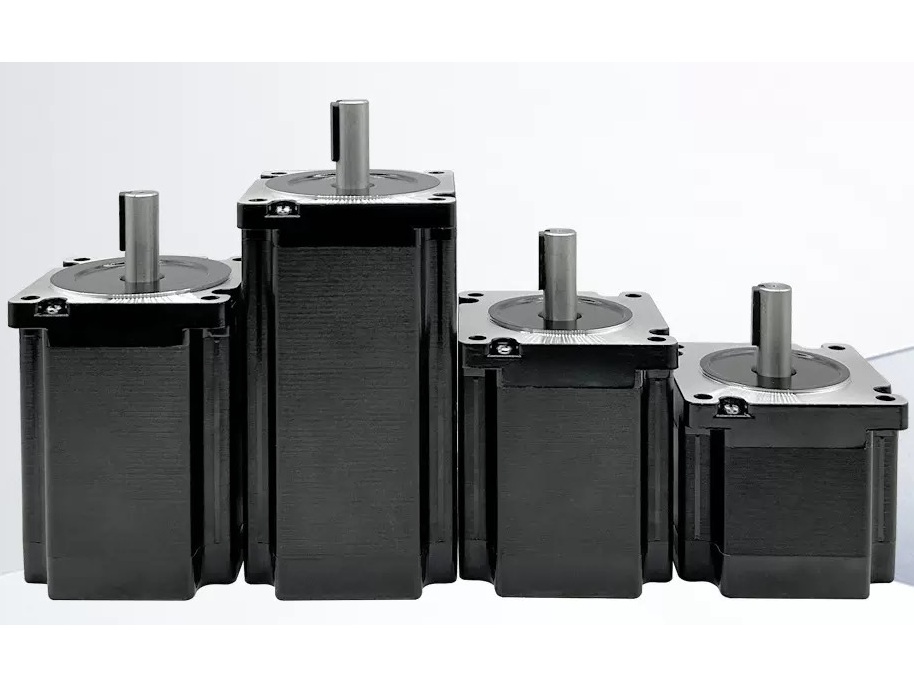
Stepper motors are widely used in CNC machines, 3D printers, laser engravers, medical devices, and automated production lines due to their precise position control, no encoder required, and open-loop operation. Choosing the right stepper motor is critical for equipment performance.
GTFI offers a complete stepper motor product line, including 42 series, 57 series, and 86 series, along with compatible stepper motor drivers, meeting needs from desktop 3D printers to industrial-grade CNC machines.
1. Stepper Motor Specifications and Frame Sizes
| Series | Frame Size | Holding Torque | Phase Current | Typical Applications |
|---|---|---|---|---|
| 42 Series | 42×42×23-48mm | 0.12-0.52 N·m | 1.0-1.8A | 3D printers, small CNC |
| 57 Series | 57×57×40-100mm | 0.5-3.0 N·m | 2.0-4.0A | Medium CNC, engraving machines |
| 86 Series | 86×86×70-150mm | 2.0-8.0 N·m | 4.0-6.0A | Heavy CNC, industrial equipment |
2. GTFI Stepper Motor Models
- 42HS23: 42×23mm, 0.12 N·m, 1.0A — suitable for small 3D printers
- 42HS48: 42×48mm, 0.52 N·m, 1.8A — suitable for medium 3D printers, test fixtures
- 57HS56: 57×56mm, 1.2 N·m, 2.5A — suitable for small CNC machines
- 57HS76: 57×76mm, 2.0 N·m, 3.0A — suitable for medium CNC, engraving machines
- 57HS100: 57×100mm, 3.0 N·m, 4.0A — suitable for heavy CNC
- 86HS118: 86×118mm, 6.0 N·m, 5.0A — suitable for industrial-grade CNC
3. Key Selection Parameters
- Torque: Sufficient holding torque is needed to overcome load inertia. Typically choose 1.5-2× the load torque.
- Current: The driver output current must match the motor's phase current. Over-current will burn the motor, while under-current reduces torque.
- Step Angle: Standard step angle is 1.8° (200 steps/revolution). Microstepping improves resolution.
- Resistance/Inductance: Affects high-speed performance and temperature rise. Low resistance and inductance are better for high-speed applications.
4. Stepper Motor vs Servo Motor
- Stepper Motor: Open-loop control, lower cost, lower speed, suitable for applications where positioning accuracy is not extremely critical.
- Servo Motor: Closed-loop control, higher cost, higher speed, higher precision, suitable for high-speed, high-precision applications.
Practical Selection Checklist
Electric motor selection is a system decision. Rated power is only one input; voltage, frequency, speed, torque, duty, starting method, mounting, enclosure, efficiency, and environmental conditions all affect whether a motor will perform reliably.
What to Confirm Before Ordering
- Define required shaft power and torque at the actual operating point rather than choosing only from the nominal machine load.
- Confirm voltage, frequency, phase, rated speed, pole count, mounting arrangement, and rotation direction.
- Check duty cycle, starting frequency, acceleration requirements, load inertia, and whether a variable-frequency drive will be used.
- Match enclosure and protection to dust, moisture, temperature, corrosive conditions, and installation location.
- Compare efficiency class, service factor where applicable, bearings, lubrication, spare parts, and maintenance access for lifecycle cost.
For a quotation request: For quotation requests, provide power, voltage, frequency, speed, mounting type, application, duty cycle, and quantity. A motor nameplate or equipment drawing is especially useful when replacing an existing unit.
Need help matching equipment to a specific application? Provide the operating conditions, required quantity, destination, and key technical requirements when requesting a quotation.
❓ Frequently Asked Questions
A: The driver output current should be equal to or slightly higher than the motor's rated current. Higher current increases torque but also increases temperature.
A: Stepper motors draw current even when stationary to maintain holding torque, which generates heat. Normal temperature rise is within 60-80°C.
A: Microstepping divides a full step into smaller increments, improving resolution and smoothness. Common microstepping values include 2, 4, 8, 16, 32, 64, and 128.
A: Skipped steps are usually caused by insufficient torque. Check if the load is too high, the driver current is sufficient, or the speed is too high.
💬 Need help selecting a stepper motor?
Talk to Our Experts →